Sumbawa from Lombok | Ferry & Flight Routes

Sumbawa from Lombok | Ferry & Flight Routes

How to read this: Sumbawa Luxury is an independent concierge guide — we curate and compare eco-luxury stays, surf trips and island experiences, then arrange your booking through a vetted operating partner. We do not own or operate the resorts, and resort or brand names (including any historical Aman/Amanwana reference) are used only as neutral examples, not claims of affiliation. Prices are by quote and vary by property, season and party; figures here are indicative. Flights, ferries and surf seasons change — confirm before you travel. This is general information, not a binding offer.

Sumbawa from Lombok is simple in structure and messy in detail: you either go overland-plus-ferry via the Kayangan (east Lombok) to Poto Tano (West Sumbawa) crossing, or you fly from Lombok Airport to Sumbawa Besar or Bima. The ferry is the default for West Sumbawa surf and overland trips; the short flights make more sense for Moyo Island, Saleh Bay and East Sumbawa.

This page decodes those routes: how the Lombok–Sumbawa ferry actually feels, what to expect on the drive, how the flights work in real life, and how to choose by destination. All logistics are based on ground-checked routes and public schedules; we never invent operators, fixed timetables or prices.

Ferry route decoded: Kayangan to Poto Tano

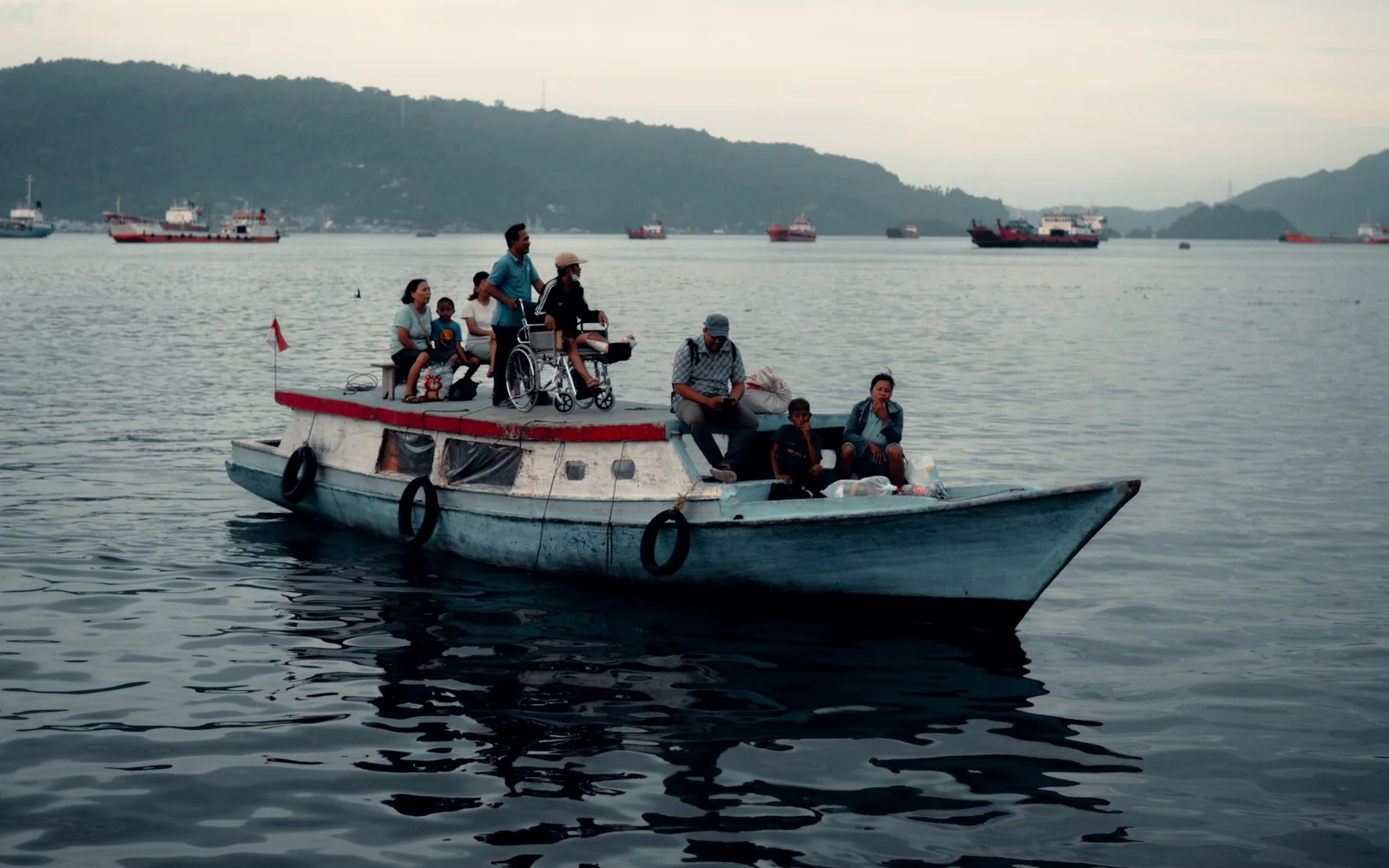
The standard way to go Lombok to Sumbawa is the public car-and-passenger ferry from Kayangan Harbour in east Lombok to Poto Tano ferry port in West Sumbawa. This crossing links straight into the Trans-Sumbawa coastal road, putting you in easy reach of West Sumbawa’s surf zones.

Route and crossing basics

Kayangan is Lombok’s eastern port; Poto Tano is West Sumbawa’s main ferry port. The strait between them is short, and on paper the crossing is simple:

  • Route: Kayangan (East Lombok) → Poto Tano (West Sumbawa)
  • Crossing time underway: typically about 1.5–2.5 hours, depending on sea conditions and the vessel
  • Total port-to-port experience: 3–5 hours accounting for check-in, loading, waiting and disembarkation
  • Vessels: large roll-on/roll-off ferries taking passengers, motorbikes and vehicles

In practice, the variable is not the sea crossing itself but the waiting time. Boats rarely leave exactly on their published slot; they load until they’re reasonably full. Departures can bunch up at peak times and thin out during the quietest hours.

Frequency: “every hour-ish”, not on the dot

The Lombok Sumbawa ferry runs essentially 24 hours, with more sailings by day than deep night. Expect:

  • Daytime: usually several departures per hour in both directions, with some clustering
  • Night: thinner schedule; you may wait 1–2 hours for the next sailing
  • Holidays/high-season: more ferries, but also more vehicles and longer queues

We treat all public schedules as indicative only. If timing matters (connecting to a domestic flight, or reaching a West Sumbawa resort before dark), we plan using conservative buffers rather than cutting things fine.

Foot passenger vs. vehicle on the Kayangan ferry to Sumbawa

You can cross as a foot passenger, with a motorbike, or in a private car/van. The trade-offs are comfort, control and total door-to-door time.

Foot passenger
Buy a walk-on ticket, board with your bag, and arrange separate drivers on each side. Flexible and cheap, but involves more coordination.
With motorbike
Common among independent surfers. You roll on, lash the bike, ride off the other side. Simple but exposed to weather and fatigue over long distances.
Private car/van
Smoothest option for surf groups or families. One vehicle picks you up at your Lombok base and stays with you through the ferry to your Sumbawa destination.

Vehicle fares are tiered by size; passenger fares by category. Recent ballpark ranges (last verified June 2026) for Kayangan–Poto Tano are roughly:

  • Foot passenger: low single-digit USD equivalent per person
  • Motorbike + rider: still within low single digits to very low double digits USD equivalent
  • Car/van + passengers: usually in the low double-digit USD equivalent band, depending on vehicle length

Tickets are bought at the port; there’s no need (or reliable way) to pre-book a specific sailing in advance for public ferries. Our concierge partner arranges your private driver, guides you to the right booth, and wraps this into a single, by-quote transfer cost so you are not juggling small payments at each leg.

On-board experience: basic, functional, occasionally crowded

These ferries are working transport, not cruise ships. Expect:

  • Simple indoor seating areas, with fans and plastic chairs or bench seating
  • Some outdoor deck space for fresh air and sea views
  • Basic canteen selling tea, coffee, instant noodles and packaged snacks
  • Toilets of varying cleanliness; carry tissues and hand sanitiser

Safety is to typical Indonesian domestic ferry standards. Lifejackets are carried; announcements are made in Indonesian. We prefer daylight crossings for first-timers, both for comfort and so your onward drive into Sumbawa happens in good light.

Driving from Mataram or Senggigi to Kayangan port

Getting to Kayangan from Lombok’s main tourist areas is an easy coastal-and-village drive, but the timing matters if you want to reduce waiting at the port and avoid arriving in West Sumbawa after dark.

Distances and realistic drive times

From Lombok’s west, the drive runs east through Mataram and along the island’s shoulder. Expect:

  • Mataram → Kayangan: around 2–2.5 hours in light to moderate traffic
  • Senggigi → Kayangan: around 2.5–3 hours, as you first run south past Mataram
  • Kuta (South Lombok) → Kayangan: often 2.5–3 hours, depending on intra-island traffic

Traffic builds around school times, local markets and during Ramadan or major holidays. We plan with a buffer so you are not racing the clock for a specific ferry.

Road quality and drive feel

The main roads to Kayangan are paved and, by Indonesian standards, straightforward. You’ll share them with trucks, buses, chickens and the full spectrum of island traffic. Expect:

  • Mostly sealed asphalt roads, with some rough patches and speed bumps through villages
  • Local driving patterns: overtaking on short straights, variable speeds, motorbikes entering from side roads without much warning
  • Frequent warungs (small eateries) and minimarts where you can stop for drinks or a bathroom break

We recommend going with a private driver rather than hiring and self-driving unless you are fully comfortable with Indonesian road culture. A driver also means you can rest after an early surf session or a long travel day.

Private transfers vs. patchwork taxis

You can technically patch this together with local taxis or ride apps on Lombok, then negotiate a separate car at Poto Tano. That can save some money but adds friction and uncertainty, especially if your Indonesian is limited.

Our default for drive Lombok to Sumbawa is a dedicated car/van and driver, booked through our vetted operating partner, staying with you from Lombok base to your Sumbawa accommodation. Pricing is by vehicle and route; recent realistic ranges (last verified June 2026):

  • Mataram/Senggigi → Maluk (via Kayangan–Poto Tano): broad band in the high double to low triple-digit USD equivalent per vehicle, depending on vehicle size, surfboard load and time of day
  • Custom routes: quoted individually once we know party size, luggage, and specific stopovers

If you’d like us to map this leg for you and stress-test timings against your flight or surf plan, you can plan your trip with us via email or WhatsApp and we’ll respond with a detailed route suggestion.

Flying from Lombok (LOP) to Sumbawa Besar (SWQ) or Bima (BMU)

If your focus is Moyo Island, Saleh Bay, whale shark trips or East Sumbawa, flying can be faster and more comfortable than the overland-plus-ferry route. Lombok International Airport (LOP) has domestic connections east to:

  • Sumbawa Besar (SWQ): for central Sumbawa and overwater access to Moyo and Saleh Bay
  • Bima (BMU): for eastern Sumbawa and surface access towards Lakey Peak and beyond

Airlines, schedules and reliability

Several Indonesian carriers run these short hops, but routes and frequencies change with demand and season. Common patterns:

  • Flight time usually around 30–50 minutes gate-to-gate
  • Typically 1–2 daily services on active routes, sometimes with gaps on certain days
  • Regional aircraft (turboprops) with modest baggage allowances

These are short domestic sectors, but they are not immune to delays, retimings or occasional cancellations, especially in the shoulder season or if aircraft are rotated elsewhere in the network.

We cross-check current schedules once you share your dates and build in room for same-day changes if you are connecting from an international arrival into Lombok.

LOP → SWQ: best for Moyo Island and Saleh Bay

Flying from Lombok to Sumbawa Besar (SWQ) makes sense if:

  • You’re heading to Moyo Island (boat transfer from the Sumbawa Besar region)
  • You’re planning Saleh Bay liveaboards or small-boat trips (whale shark encounters are seasonal and never guaranteed)
  • You want to access central Sumbawa with minimal overland time

From SWQ, expect:

  • Airport → Sumbawa Besar town / coastal jetties: roughly 30–60 minutes by car, depending on exact jetty or resort pickup point
  • Boat transfers: run by your chosen lodge or charter, and quoted separately

LOP → BMU: for East Sumbawa and Lakey-bound travellers

Flying from Lombok to Bima (BMU) positions you in East Sumbawa, closer to overland access for Lakey Peak and the more remote eastern breaks. From BMU:

  • Bima Airport → Bima town: a short drive, often under 30–45 minutes
  • Bima → Lakey Peak: typically 3–4.5 hours by car, depending on roadworks and weather

This route suits surfers and travellers who want to avoid the long West–East Sumbawa drive, or who are building an east–west island traverse into a longer Indonesian itinerary.

Costs and baggage realities

Indicative one-way fares for these domestic sectors (last verified June 2026) often sit in:

  • Economy seat-only: low to mid double-digit USD equivalent per person, varying strongly by airline and booking window
  • Including checked luggage: add-on fees can push this toward the upper end of that band if you’re travelling with heavy surfboard bags

Surfboards are usually accepted but may incur oversize or sports-equipment fees. Exact costs and size limits vary by airline and change more often than this guide. On request, we’ll confirm current rules for your dates and boards before you commit to a routing.

Ferry vs flight: which to pick by destination

The right route from Lombok to Sumbawa depends on where you’re going, how you travel, and how much time you have. This comparison table summarises the main options:

Destination focus Best primary route Why it works Key trade-offs
West Sumbawa surf (Maluk, Sekongkang, Scar Reef area) Drive to Kayangan + ferry to Poto Tano + private car Direct access into West Sumbawa without backtracking; easy with boards and groups. 3–5h port experience + 3–4h onward drive; basic ferry comfort.
Lakey Peak & central–east surf by road Either Kayangan–Poto Tano + long drive, or flight LOP→BMU + drive Ferry route is cheaper and scenic; BMU route saves overland hours. Ferry = more variables; flight = baggage rules and airline reliability.
Moyo Island, Saleh Bay Flight LOP→SWQ + boat transfer Shortest overall travel time to coastal jetties and liveaboards. Dependent on flight schedules and sea conditions for boat transfer.
Exploring Sumbawa overland, west to east Drive + Kayangan–Poto Tano ferry Freedom to stop along the Trans-Sumbawa route; more flexible. Longer total journey; less predictable day-to-day timing.

Ferry: best for West Sumbawa and surf road trips

If your priority is West Sumbawa surf — Maluk, Jelenga, Sekongkang and the reef passes beyond — the overland-plus-ferry route is almost always the most logical. You avoid doubling back from Sumbawa Besar or Bima, and you travel with your boards and gear in one vehicle the whole way.

The experience feels like a classic island road trip: changing light over rice fields, ferry decks full of families and traders, then that first view of Sumbawa’s dry hills rising over a narrow blue strait.

Flights: best for Moyo, Saleh Bay, and time-poor travellers

If you are heading to a remote-luxury lodge on Moyo Island, or timing is tight on a short itinerary, flying will usually win. You remove the ferry-wait variable and compress most of the journey into one short hop and one sea transfer.

Flights are also a strong choice if you value comfort over the road-trip feel, or if you are connecting from a long-haul into Bali and sliding across to Lombok on a domestic leg. You arrive fresher, and your time in Sumbawa is spent on the water or at your lodge, not in transit.

Cost, comfort and risk tolerance

In broad terms:

  • Ferry + driver: often cheaper on a per-person basis for groups or families, more atmospheric but less predictable in timing.
  • Flights: more expensive up front, more regulated, but exposed to airline schedule changes.

We’ll walk you through the options for your dates and priorities, including seasonal patterns and specific connection risks for your route. Our role is to match the route to your appetite for variables, not to push one choice over another.

Onward from Poto Tano: Maluk, Lakey, Moyo and more

Once you land in Sumbawa — by ferry or by flight — the real journey begins. Distances here are real, horizons are wide open, and services thin out between key hubs. This section outlines typical onward legs from Poto Tano, Sumbawa Besar and Bima.

Poto Tano to Maluk and West Sumbawa surf

From Poto Tano ferry port, the main coastal road winds along bays and headlands before turning inland toward Maluk and the surf coast.

  • Poto Tano → Maluk: typically around 3–4 hours by car
  • Road conditions: mostly paved; some sections can be potholed or under repair after heavy rain

The drive is scenic in a dry, wide-open way: low hills, water buffalo, kids waving from roadside villages, occasional glimpses of empty bays that few visitors ever see from the water. Fuel and snacks are available at small stations and warungs along the way, but this is not a highway lined with convenience stores; we encourage stocking up in Lombok or Sumbawa’s main towns.

Poto Tano to Lakey Peak by road

You can technically reach Lakey from Poto Tano by staying on the Trans-Sumbawa route, tracking east. This is a longer haul:

  • Poto Tano → Lakey area: often 8–10+ hours of driving, depending on breaks and roadworks

That can be worthwhile if you are planning an overland traverse, surfing en route, or staying in West Sumbawa first. If Lakey is your sole target, flying into Bima and driving from the east is usually more efficient.

Sumbawa Besar to Moyo Island and Saleh Bay

From Sumbawa Besar (SWQ region), you’re looking at a sea transfer rather than a simple car ride:

  • Airport → jetty: around 30–60 minutes by road
  • Jetty → Moyo Island lodge: timing varies by vessel and sea state, but expect a modest boat ride rather than a long open-ocean crossing
  • Jetty → Saleh Bay boats: depends on your charter operator and chosen anchorage

These legs are usually handled by your chosen lodge or charter. We help you choose the right pairing of flight and boat window so that you are not overnighting unnecessarily in Sumbawa Besar unless you want to.

Bima to Lakey and East Sumbawa

From Bima (BMU), Lakey is a straightforward, if longish, surface sector:

  • BMU → Lakey area: usually 3–4.5 hours by private car, depending on road conditions

The route runs through agricultural land and small towns before dropping toward the coast. Services are basic but sufficient; this is a leg where a reliable vehicle and driver matter more than any particular “scenic stop.”

How this fits into your wider Sumbawa planning

Getting Sumbawa from Lombok right is one part of the equation. The rest is matching seasons, swell patterns, and your own travel style. We keep the logistics honest and the trade-offs explicit.

Seasonality and sea conditions

Sumbawa’s dry season broadly runs from May to September, with shoulder seasons at either end. For surfers, that dry period aligns with more consistent swell and offshore winds in key zones. For Moyo and Saleh Bay, calmer seas improve boat-based experiences and reduce the risk of weather-related delays.

Wet-season travel is entirely possible, but you should be prepared for:

  • Heavier rain affecting road conditions in some sections
  • Occasional port or boat-disruption days in stronger weather
  • More flexible, buffer-based itineraries rather than tight, same-day connections

Our separate guide on the best time to visit Sumbawa goes deeper on month-by-month trade-offs for surf, sea conditions and crowd levels.

Comparing Sumbawa vs Lombok as bases

Lombok has developed beaches, easy dining options and a broader flight network. Sumbawa is rawer, quieter and more dispersed. If you’re deciding where to spend more time, our Sumbawa vs Lombok comparison unpacks the differences in surf character, comfort level and access in plain language.

For many travellers, the sweet spot is a split itinerary: a few days to decompress in Lombok, then a committed leg into Sumbawa for surf or sea immersion, using the routes outlined on this page.

How we work: guide and connector, not operator

Sumbawa Luxury is an editorial guide and concierge, not a tour operator. We don’t run boats or own villas. Instead, we:

  • Research and publish honest, comparative guides to routes, regions and experiences in Sumbawa
  • Curate a small set of vetted local logistics and hospitality partners
  • Connect you to the right partner to actually book your transfers, stays and charters

No one can pay to change what we publish; if you proceed with our partner they may pay us a referral fee at no extra cost to you. That separation keeps our comparisons frank. If one route or region is simply a better fit for your plans, we will say so.

If you’re ready to sketch out your own Lombok–Sumbawa route — ferry, flight or both — you can plan your trip with us and our partner team will follow up via email or WhatsApp with suggested legs and by-quote ranges.

What we coordinate for you

Our Logistics & Access remit is narrow and deep: we don’t package generic tours; we design robust routes in a frontier-feeling island. For the Lombok–Sumbawa leg, that looks like:

For ferry-based itineraries

  • Advising on the best travel day and rough departure window for your route and season
  • Private car/van from your Lombok base to Kayangan, including space for surfboards and gear
  • On-the-ground support at Kayangan to purchase the correct tickets and board efficiently
  • Private vehicle and driver meeting you at Poto Tano and driving on to Maluk, Sekongkang or onward points
  • Conservative timing plans to avoid after-dark arrivals on unfamiliar roads unless you specifically request it

For flight-based itineraries

  • Comparing route options via Bali vs Lombok into SWQ or BMU for your dates
  • Stress-testing flight times against boat departures for Moyo and Saleh Bay
  • Arranging private transfer vehicles at SWQ or BMU through our local partner
  • Fact-checking baggage and surfboard rules for your chosen carrier at planning time

For hybrid or overland traverses

  • Designing west–east or east–west Sumbawa traverses that link multiple surf zones or sea experiences
  • Building in realistic rest days between longer road sections
  • Aligning your exit point back into Lombok or onward into Flores/Komodo

We handle this in close conversation: WhatsApp voice notes, map screenshots, and straight answers about what is and isn’t realistic for your group. To start that process, plan your trip and we’ll continue the conversation 1:1.

Related guides and further reading

FAQs: Sumbawa from Lombok

How long does the Lombok to Sumbawa ferry take?

The Kayangan to Poto Tano crossing usually takes about 1.5–2.5 hours underway. Including waiting, loading and disembarkation, plan on 3–5 hours port-to-port, plus your drives on either side.

Can I drive my car or motorbike on the Kayangan ferry to Sumbawa?

Yes. The Kayangan–Poto Tano ferry is a roll-on/roll-off service that carries motorcycles, private cars and larger vehicles as well as foot passengers. You pay a vehicle fare (tiered by size) plus passenger fares, all purchased at the port.

Is it better to fly or take the ferry from Lombok to Sumbawa?

For West Sumbawa surf (Maluk, Sekongkang), the ferry plus private car is usually best. For Moyo Island, Saleh Bay or if you’re short on time, flying from Lombok to Sumbawa Besar or Bima can be more efficient. We compare both for your dates and priorities before recommending a route.

How far is it from Poto Tano to Maluk?

From Poto Tano ferry port to Maluk is typically a 3–4 hour drive on mostly paved roads, depending on traffic, roadworks and stops. It’s comfortable in a private car or van and is a standard leg in West Sumbawa surf itineraries.

Can you arrange my full transfer from Lombok to my Sumbawa hotel?

We don’t operate vehicles ourselves, but we work with a vetted local partner who does. Share your Lombok start point and Sumbawa destination via our plan your trip page, and they’ll propose a route with by-quote pricing, coordinating via email or WhatsApp.

Plan Your Trip
WhatsAppPlan Your Trip